TIPYAN Center Successfully Hosts Training Workshop on Impact Evaluation in Qatar’s Food Systems
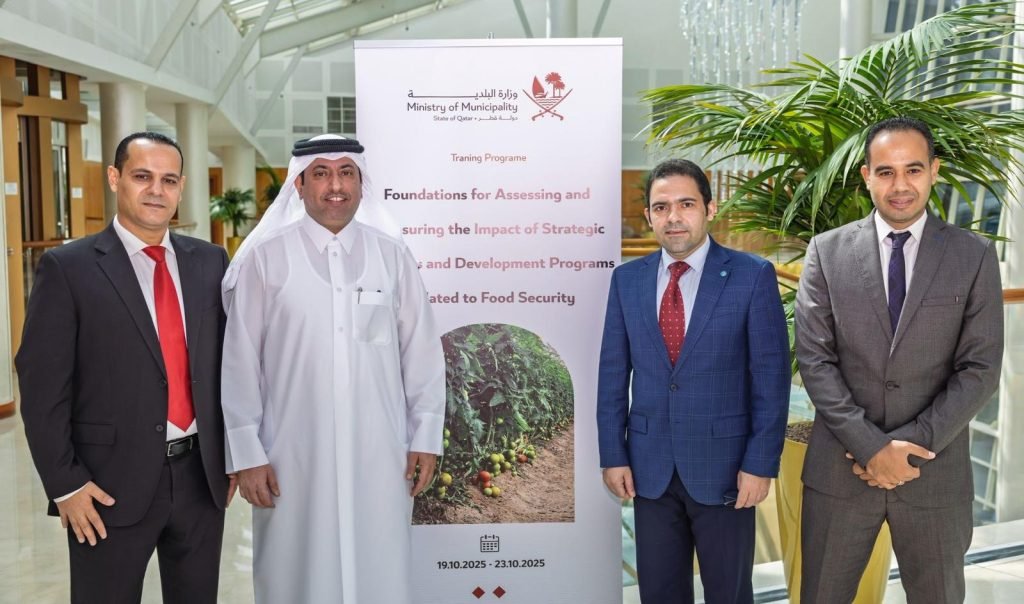
Doha, Qatar – October 31, 2025 – In a significant step toward enhancing agricultural research capabilities, TIPYAN Center for Economics and Development Policies has successfully conducted a specialized training workshop in collaboration with the Agricultural Research Center under Qatar’s Ministry of Municipality. Held last week in Doha, the program focused on the impact evaluation of research and development interventions within the food system, equipping participants with essential tools to assess and improve food security initiatives.
The 5-day workshop drew 42 participants primarily researchers and affiliated staff from the Agricultural Research Center. This diverse group included agronomists, policy analysts, and development specialists, all eager to deepen their expertise in evaluating the effectiveness of interventions aimed at bolstering Qatar’s food security amid global challenges like climate change and supply chain disruptions.
Led by Professor Dr. Assem Abu Hatab and Dr. Mohamed Abdel Hamid, the intensive training spanned five days and combined theoretical sessions with practical applications. Dr. Abu Hatab opened the program with an overview of impact evaluation methodologies, emphasizing randomized controlled trials (RCTs), quasi-experimental designs, and econometric models tailored to agricultural contexts. Dr. Abdel Hamid complemented this by delving into real-world case studies from the Middle East and North Africa region, illustrating how these techniques can measure the outcomes of R&D projects, such as sustainable farming practices and crop resilience programs.
Participants engaged in hands-on activities, including group exercises on data analysis, and simulations of evaluating hypothetical food system interventions. Topics covered included identifying causal impacts, addressing selection bias, and integrating qualitative assessments with quantitative data. The curriculum also highlighted the role of impact evaluation in policy-making, particularly in aligning research with Qatar’s National Food Security Strategy, which aims for self-sufficiency in key agricultural sectors.
“This collaboration underscores our commitment to building local capacity in evidence-based decision-making,” said the research director of the TIPYAN Center, Professor Shaimaa Reda. “By partnering with the Ministry of Municipality’s Agricultural Research Center, we are fostering a new generation of researchers who can drive sustainable development in Qatar’s food ecosystem.”
The workshop received overwhelmingly positive feedback from attendees, who praised its relevance and interactive format. Mrs. Aaisha Al-Kuari, from the Agricultural Research Center, shared her experience: “The training was eye-opening. Learning about advanced impact evaluation methods has given me the confidence to apply these in our ongoing projects on drought-resistant crops. It is exactly what we needed to ensure our interventions make a real difference in food security.”
Another participant, Engineer Khalid Ibrahim, added: “The facilitators were exceptional and their insights into regional case studies were particularly inspiring. I will start incorporating the acquired knowledge into my work on irrigation efficiency. This workshop will undoubtedly elevate the quality of our research outputs.”
Looking ahead, the TIPYAN Center hinted at more initiatives on the horizon, including follow-up sessions and potential expansions to other sectors. Stay tuned for more!