

Turning Agricultural Waste into Farm Inputs: What Farmer Evidence Tells Policymakers
Would farmers swap chemical fertiliser for products made from manure? A choice experiment with 555 farmers in seven European countries shows most are open to it, if the product is concentrated, reliable in nitrogen content and priced well below mineral fertiliser.
Too many nutrients in one place, too many imports in another
Europe imports a great deal of its crop nutrients as chemical fertiliser. In 2014, European farmers used about 10.7 million tonnes of nitrogen in this form, along with large amounts of phosphate and potash. At the same time, regions with intensive livestock farming produce more manure than the land can legally absorb, so disposing of it is costly. Where chemical fertiliser was once a supplement, manure has come to be seen by many farmers as a waste product, even though it is full of nutrients.
One way out is to process manure and other farm residues into bio-based fertilisers that are easier to store, transport and apply. That would cut fertiliser imports and keep nutrients circulating within farming. But a product is only useful if farmers will actually buy it.
The question: what would it take?
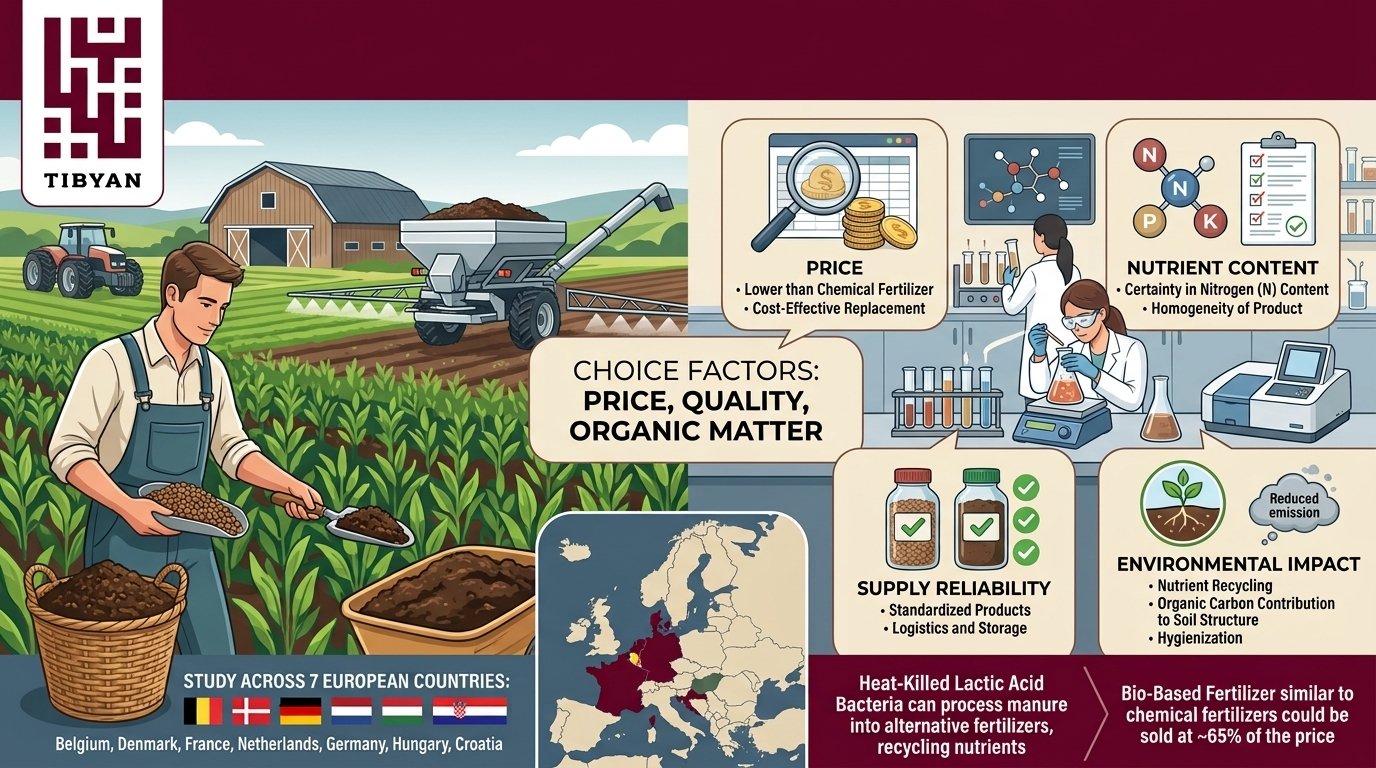
Much of the earlier research focused on the processing technologies themselves. This study asked the buyers. Researchers from Ghent University, the University of Copenhagen and ILVO, working within the EU-funded INEMAD project, surveyed 555 farmers in Belgium, Denmark, France, the Netherlands, Germany, Hungary and Croatia. For analysis, the countries were grouped into four regions according to whether they have a surplus, a balance or a shortage of organic nutrients.
How the study worked
The core of the survey was a choice experiment. Each farmer saw six choice situations. In each, they picked between two described bio-based fertilisers or kept their current chemical fertiliser. The products differed on seven features: price (up to 60% cheaper than chemical fertiliser), physical form, the volume needed, certainty about nitrogen content, organic carbon, hygienisation (treatment to reduce pathogens and weed seeds) and speed of nutrient release. Because farmers had to trade one feature against another, the results show how much each one is worth to them.
What farmers said
- Most were open to switching. Farmers chose a bio-based option in about 70% of choices and kept the chemical fertiliser in about 30%. Forty-eight farmers always chose the chemical option.
- Certainty and convenience came first. Across regions, farmers preferred products with a known nitrogen content, solid and concentrated forms, a similar volume to chemical fertiliser, and a lower price.
- Other features depended on the region. Organic carbon, hygienisation and fast nutrient release mattered significantly in some countries but not in others.
- Farmers wanted something close to what they already use. The preferred bio-based product looked a lot like conventional fertiliser, with the addition of organic carbon in several regions.
Two kinds of farmers
A further analysis split respondents into two groups. About three-quarters leaned towards bio-based products, valuing organic carbon and hygienisation and showing no attachment to their current fertiliser. These farmers were more often livestock or horticulture producers who had experienced nutrient shortfalls with manure and who already knew about bio-based products. The remaining quarter preferred business as usual: solid form, certain nitrogen and fast release, like chemical fertiliser. This group included more crop producers, more farmers over 50, and a large share of the Danish respondents. The finding hints that better information could move more farmers towards the first group.
What would farmers pay?
Because price was one of the features, the researchers could estimate what each feature is worth, expressed as a share of the chemical fertiliser price. Uncertainty about nitrogen content lowered the value, and so did needing to spread larger volumes. Solid form, hygienisation and organic carbon raised it. Putting the preferred features together, the study estimates that a bio-based fertiliser closely matching chemical fertiliser could sell for roughly two-thirds to three-quarters of the mineral fertiliser price. The estimates also showed value climbing with each processing step, from raw manure, which farmers valued at close to nothing, to homogenised and hygienised products.
Why it matters for development, food security and climate resilience
The study is European, but the question it asks reaches well beyond Europe: will farmers adopt a recycled input, and on what terms? Fertiliser is one of the main drivers of rising farm operating costs, and any region that wants to lower input costs, use agricultural by-products and build more resilient farming systems faces the same adoption challenge.
Three lessons stand out for evidence-based policy. First, adoption depends on reliability and price at least as much as on environmental benefits. Farmers want predictable nutrient content and a clear discount. Second, information and trust matter, because farmers who knew more about bio-based products were more open to them. Third, regulation shapes markets. The authors note that processed manure products are often held to the same rules as raw manure, and farmers in Flanders and the Netherlands hoped that the rules would change so that products with mineral-fertiliser-like properties are treated accordingly.
These are the questions Tipyan’s work on sustainable livelihoods, food security and climate resilience keeps coming back to: how to turn good technical ideas into products that people will use, and how to design policy, capacity building and partnerships that make that happen.
Limits and next steps
The results come from stated preferences in a hypothetical survey, not from observed purchases. Farmers were recruited through fairs and farmer organisations, and some countries (France and the Netherlands in particular) had only a few dozen respondents, so findings are best read as regional patterns. The authors also stress that what farmers want is not always easy for processors to deliver, because of technical, legal and logistical constraints. Testing these preferences with real products and real prices, and in other regions, would be the natural next step.
Read the original paper
Tur-Cardona J., Bonnichsen O., Speelman S., Verspecht A., Carpentier L., Debruyne L., Marchand F., Jacobsen B.H., Buysse J. (2018). Farmers’ reasons to accept bio-based fertilizers: A choice experiment in seven different European countries. Journal of Cleaner Production, 197, 406–416. https://doi.org/10.1016/j.jclepro.2018.06.172
This summary is an original plain-language account of the published study. All rights in the original article remain with its publisher and authors.