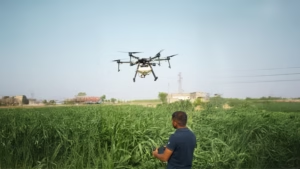
Artificial intelligence is rapidly transforming industries across the globe, and the food system is no exception. From precision agriculture and quality inspection to supply chain optimization and demand forecasting, AI applications offer tremendous potential to enhance productivity, reduce waste, and improve food safety. Yet despite this promise, adoption across the food system remains highly uneven, with significant gaps between large enterprises and smaller actors, between different segments of the value chain, and between developed and developing country contexts. In Egypt, where the food system employs a substantial portion of the workforce and is central to food security and economic stability, understanding how to harness AI’s potential across the full spectrum of food system actors has become an urgent priority.
The Tipyan Center is launching a groundbreaking initiative to understand and accelerate AI adoption across Egypt’s diverse food system actors, ranging from smallholder farmers and agricultural cooperatives to food processors, distributors, wholesalers, retailers, and logistics providers. For the first time, we are developing a comprehensive tool to measure exactly how ready these various actors are to harness AI and what it takes for them to succeed in implementing these transformative technologies.
At the heart of our project is the creation of a novel readiness framework designed specifically to assess the capacity of food system actors to adopt AI. This instrument measures six critical dimensions that determine whether an organization can successfully harness AI for business benefit. These dimensions include strategic vision and leadership commitment, which captures whether leadership has a clear AI strategy and has allocated appropriate resources. They also encompass data and digital infrastructure, examining the hardware, software, connectivity, and data management capabilities available to different actors across the food chain. The framework assesses human capital and innovation capabilities, measuring the availability of technical talent, investment in research and development, and collaboration with external innovation partners. Governance and responsible AI use is another key dimension, addressing whether appropriate data privacy policies, cybersecurity protocols, and ethical guidelines are in place. Organizational adoption capability examines digital transformation strategy, training culture, and system interoperability, while organizational resilience and sustainability captures change management capacity, workforce transition planning, and environmental sustainability awareness.
What makes our approach distinctive is its attention to the full diversity of food system actors. Rather than assuming a uniform pathway to AI adoption, we recognize that a smallholder farmer faces very different opportunities and constraints than a large food processing company, a wholesale distributor, or a retail chain. Our framework is designed to be flexible enough to capture these differences while maintaining a common analytical structure that enables meaningful comparison across value chain segments. This allows us to identify where the greatest opportunities for AI deployment exist, where the most significant barriers are concentrated, and which types of actors require which forms of support.

We are also examining not simply whether food system actors can adopt AI in theory, but whether their decision-makers will choose to adopt it in practice. Using established behavioral models extensively validated across sectors and technologies, we are investigating the perceptions, social influences, and facilitating conditions that shape adoption decisions across different types of actors. This allows us to understand why structurally ready organizations may or may not actually implement AI, providing richer insights for policy design and targeted interventions.
Equally important, we are tracking how AI adoption affects concrete outcomes that matter across the food system. Our framework captures a comprehensive set of performance dimensions including financial performance such as revenue, profit margins, and cost savings; market performance including market share and customer base expansion; operational performance covering productivity, production efficiency, and supply chain optimization; product quality and food safety, which is critical for actors serving regulated domestic and international markets; innovation performance related to new product introduction and process innovation; and sustainability performance including resource efficiency, waste reduction, and emissions reduction. This comprehensive approach goes beyond narrow financial metrics to capture outcomes that are particularly critical for the food system, where quality failures, food loss, and environmental footprint are key determinants of competitiveness, food security, and long-term sustainability.
The project carries significant implications for policymakers, food system actors, and Egypt’s economy and society more broadly. For policymakers, our research will provide evidence-based insights to design targeted support programs that address the real barriers different categories of food system actors face. Rather than adopting one-size-fits-all approaches, our framework helps identify which actors need what kind of support, whether that involves financial incentives, technical assistance, training programs, infrastructure investments, or improvements to the broader regulatory and institutional environment. For food system actors, the framework offers a practical self-assessment tool to benchmark their AI readiness against peers in similar value chain positions, identify priority areas for investment, and understand the potential returns from AI adoption. For Egypt’s economy and society, accelerating AI adoption across the food system is critical for enhancing food security through improved productivity and reduced post-harvest losses, boosting agricultural and food exports by meeting international quality and safety standards, creating skilled employment opportunities in rural and peri-urban communities, reducing food waste and environmental impact throughout the value chain, and building a more resilient and competitive food system capable of withstanding future shocks.
Over the coming months, the Tipyan Center will refine and validate our readiness framework through consultations with diverse food system actors across Egypt, conduct a national assessment to establish baseline readiness levels across different segments of the value chain, develop practical guidance and policy recommendations based on our findings, and create accessible tools for actors to assess their own AI potential. We are committed to ensuring that our research translates into tangible benefits for the businesses, organizations, and communities we study.
We invite policymakers, industry associations, development partners, and food system actors of all types to engage with this initiative. Together, we can ensure that Egypt’s food system, the backbone of our economy and food security, does not miss the AI revolution. The Tipyan Center is dedicated to evidence-based research that drives innovation, competitiveness, and sustainable development across Egypt’s food system, and we believe this project represents a significant step toward realizing the full potential of AI for Egyptian agriculture, food processing, distribution, and consumption. By taking a holistic view of the food system and addressing the diverse needs of its many actors, we can build a future where AI serves not only to enhance productivity and profitability but also to advance food security, sustainability, and shared prosperity across Egyptian society.