

Food Safety Starts in the Field: Adoption Lessons for Mycotoxin Control
Fusarium and its mycotoxins threaten grain safety and trade. A study of 190 wheat farmers in Spain and Lithuania asked whether they would adopt precision spraying and selective harvesting. About four in five were open to it, motivated by lower fungicide use and emissions, not profit alone.
A toxin you cannot see in the field
Wheat and barley can be infected by Fusarium fungi, which cause a disease called Fusarium head blight. The fungus also produces mycotoxins, notably deoxynivalenol (DON), that harm people and livestock and can get a harvest rejected by buyers. Mycotoxins are described in the paper as the most widespread food-related health risk in EU field crops such as wheat and barley.
Today, most farmers have no reliable way to measure toxin levels before harvest. The usual response is to spray fungicide uniformly over the whole field, then harvest everything together and store it in one place. Yet infection varies from one patch of a field to another, depending on soil, crop density and microclimate. Treating the whole field the same way spends money and chemicals where they are not needed, and mixes clean grain with contaminated grain.
A smarter alternative: treat each zone differently
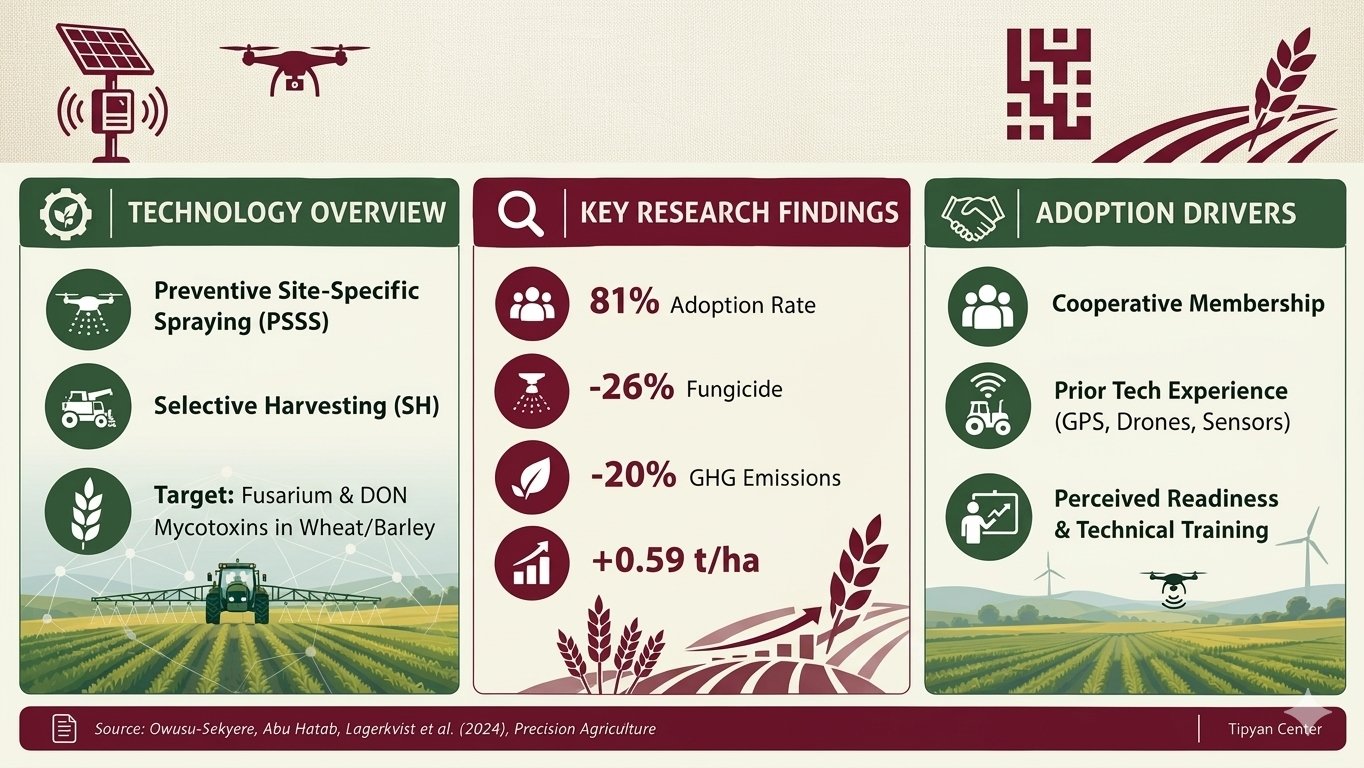
The technology studied combines two precision tools, which the authors call PSSS-SH. In preventive site-specific spraying (PSSS), a hyperspectral camera mounted on a tractor and forecasts of disease development produce a map of infection risk, and fungicide is applied at a higher dose where risk is high and a lower dose where it is low. In selective harvesting (SH), a map of predicted DON levels is used to sort the crop at harvest into three streams: grain for human food, grain for animal feed, and grain for bioenergy. The aim is to keep the safest grain for the most valuable market and to reduce the toxin risk reaching food and fodder.
The question: will farmers adopt it?
A good technology only helps if farmers use it. A research team led from the Swedish University of Agricultural Sciences, working with partners in Spain, Lithuania and Belgium, interviewed 190 commercial wheat farmers face to face between September 2022 and May 2023: 129 in Spain and 61 in Lithuania. Farmers were shown a series of hypothetical versions of the technology and asked to choose between them or to keep their current practice. The versions differed in six features: how much fungicide use would fall, how much greenhouse gas emissions would fall, the yield gain, the profit gain from selective harvesting, the profit gain from precision spraying, and the extra yearly investment per hectare.
The survey also asked about attitudes: how useful the farmer thought the technology would be, how ready they and their advisers felt, how strongly they wanted to use it, and what the people around them expected. These questions draw on two well-known models of how people accept new technology.
What farmers said
- Most were open to it. About 81% of farmers fell into a group that favoured the technology and was willing to pay for it. The other 19% preferred to stay with their current practice.
- Cost matters. In both countries and both groups, a higher investment cost made farmers less likely to choose the technology.
- Environmental benefits carried real weight. For the main group, cutting emissions by 20% and cutting fungicide use by 26% were worth the most, at roughly €100 and €78 per hectare in the model’s estimates, ahead of the profit and yield gains.
- Profit is not the whole story. The authors conclude that farmers also value non-financial benefits, and that these line up with the choices they actually made.
- Countries differ a little. Spanish farmers cared more about yield gains, while Lithuanian farmers were also interested in a smaller fungicide reduction.
Who is more likely to adopt?
Farmers who favoured the technology tended to be members of cooperatives, to have a job outside the farm, to earn a larger share of household income from grain, and to have used other precision tools such as drones, sensors or GPS before. They were also more likely to see the technology as useful, to feel ready to use it, and to want it. In this sample, men were less likely than women to favour it, which the authors read as a sign of gender differences in uptake that deserve attention.
Why it matters for development, food security and climate resilience
Mycotoxins are a food safety problem, a trade problem and a livelihood problem at the same time, and they are a concern wherever cereals are grown and traded, including in the Middle East and North Africa. The study is European, but its lessons are broader. Technology adoption depends less on the technology itself than on whether farmers see it as useful, feel ready to use it, can afford it and trust the people recommending it.
Four lessons stand out for evidence-based policy. First, promote the environmental benefits together with the economic ones, because farmers respond to both. Second, invest in training and advice so that farmers understand what a new tool does and how it fits their existing machinery. Third, use cooperatives as channels for knowledge, access and shared investment. Fourth, design programmes with gender in mind, so that adoption support reaches everyone.
These are the questions at the heart of Tipyan’s work on food security, climate resilience and sustainable livelihoods: how to turn good technical ideas into practice through capacity building, partnerships and policies that match how farmers actually decide.
Limits and next steps
The results come from stated choices in a survey, not from observed purchases. The sample covers two countries, the Lithuanian group is much smaller than the Spanish one, and only wheat farmers were interviewed even though the technology was designed for wheat and barley. The authors suggest repeating the work in other countries with similar Fusarium risk and including barley growers. Testing the technology in real farm trials alongside surveys such as this one would show whether stated willingness turns into adoption.
Read the original paper
Owusu-Sekyere E., Abu Hatab A., Lagerkvist C.-J., Pérez-Ruiz M., Šarauskis E., Kriaučiūnienė Z., Almoujahed M. B., Apolo-Apolo O. E., Mouazen A. M. (2024). Farmers’ willingness to adopt precision agricultural technologies to reduce mycotoxin contamination in grain: evidence from grain farmers in Spain and Lithuania. Precision Agriculture, 25, 2292–2320. https://doi.org/10.1007/s11119-024-10167-4
This summary is an original plain-language account of the published study. The original article is open access under a Creative Commons Attribution 4.0 licence. Credit to the authors and a link to the source are retained.