
A Hidden Part of City Life
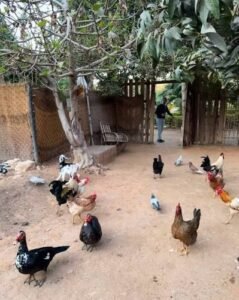
Walk through the back streets of almost any Egyptian city and, sooner or later, you will hear it before you see it: the cluck of chickens, the bleat of a goat, the rustle of rabbits or pigeons in a rooftop coop. Urban livestock keeping is everywhere in Egypt’s cities, and yet it is almost invisible in official policy. It sits in a grey zone; technically discouraged, rarely enforced, and largely unstudied.
That gap matters more than it might seem, because Egypt, like much of North Africa, is under real food security pressure. Climate stress, economic shocks, and a rapidly growing population are combining to squeeze household budgets and diets at the same time. And the pressure is increasingly an urban story. Egypt’s cities are growing fast, and much of that growth is happening not in Cairo or Alexandria, but in the country’s smaller, secondary cities; the kind of mid-sized urban centres that rarely make it into national headlines or international research.
That is precisely where most of the global evidence base falls short. Research on urban agriculture and food security has historically clustered around a handful of megacities, and around crops rather than animals. Livestock keeping, despite being a common, longstanding urban practice across the developing world, has been a minor footnote in a literature dominated by rooftop gardens and community plots. As a result, we know surprisingly little about who keeps livestock in a city like this, why they do it, and whether it actually makes a meaningful difference to what ends up on the family’s plate.
That is the gap our research set out to close.
The project goals
The aim of our project is to generate the first rigorous, causally grounded evidence on urban livestock keeping in an Egyptian secondary city, using Fayoum, a mid-sized city with a long agricultural heritage, as our case study. We want to understand three things in particular: who in the city actually keeps livestock and why; whether doing so translates into measurably better food security and diet quality for the household; and, if it does, what that means for how city and national authorities should think about the practice going forward.
We also wanted to push the evidence a step further methodologically. Much of what we know about urban agriculture and food security comes from studies that can show a correlation, livestock-keeping households tend to eat somewhat better, without being able to say whether the livestock keeping caused that difference, or whether households that were already a bit better off were simply more likely to take it up in the first place. We want to move beyond that correlation and get at something closer to a causal answer.
How we did it: a mixed-method approach
To answer these questions, the TIPYAN research team combined several complementary approaches. We began by working closely with local experts and stakeholders at Fayoum University and in the community to design and pilot a household survey that reflected the real, lived context of urban livestock keeping in the city; not just a generic template imported from elsewhere. That local grounding shaped everything from the wording of our questions to the food security measures we used.
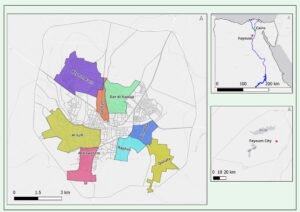
Figure 1. Study areas in Fayoum City
We then carried out a large household survey across Fayoum’s urban and peri-urban neighbourhoods, administered face-to-face by trained local enumerators, capturing detailed information on household characteristics, livestock-keeping practices, and what people actually ate. To ensure the practice was measured fairly, we also looked not just at how many different food groups a household consumed, but at how much of each they ate, a refinement to standard food security measurement that turned out to matter a great deal for a practice like livestock keeping, whose main contribution may be in quantity and quality rather than sheer variety.
Finally, and this is the step that let us move beyond simple correlation, we used statistical techniques designed specifically to construct a fair comparison between livestock-keeping and non-livestock-keeping households; in effect, comparing households that look alike in every important respect except for whether they keep animals. We deliberately leave the technical details of that econometric approach to the academic paper; what matters for this post is the intuition: this lets us speak with much more confidence about what livestock keeping actually does for a household, rather than simply what it is associated with.
What our results show
Without getting into specific numbers, here is the broad shape of what our results tell us. First, urban livestock keeping is not evenly spread across the population; it follows a clear pattern. Households living in peri-urban areas, larger households, and households with somewhat higher incomes are considerably more likely to keep livestock. So too are households whose head is self-employed or runs a small business, which makes intuitive sense: livestock needs daily attention, and the flexible schedule that comes with self-employment makes that far easier to manage than a fixed job would. Interestingly, the practice is notably less common among more educated households and among male-headed households, hinting that livestock keeping in this setting is closely tied to who in the household manages food provisioning day to day, and to the practical constraints of time and space that shape which households can realistically take it on.
Second, and this is perhaps the most important nuance in our findings: livestock keeping does not appear to meaningfully ease the subjective experience of food insecurity; the day-to-day worry about whether there will be enough to eat. But it does produce clear, robust improvements in the actual quantity and nutritional quality of what these households eat, particularly in access to vitamin-A-rich and protein-dense foods. In other words, livestock keeping does not seem to resolve the anxiety of food insecurity, but it does put more, and better, food on the table. That is a subtle but important distinction, and one that has real implications for how the practice should, and should not, be talked about by policymakers.
Third, these dietary benefits are not universal. They are concentrated among households that are already keeping livestock, rather than spread evenly across the whole population. This tells us that simply encouraging more households to take up livestock keeping, without attention to who is realistically able to do so, is unlikely to deliver the same benefit to everyone.
Finally, we also modelled how things might shift under two plausible future scenarios: an expansion of available urban space for keeping animals, and an increase in the pace of rural-to-urban migration into the city. Both scenarios would be expected to shift patterns of livestock keeping and its food security contribution, but the size and even the direction of these effects varies depending on which outcome you look at, reinforcing that this is not a one-size-fits-all story.
What this means for policy
These findings point toward a measured, rather than sweeping, set of recommendations.
- Move from silent prohibition to proportionate recognition: Urban livestock keeping in Egypt currently exists in a policy grey zone: technically restricted, but so widely practiced that the restriction is not meaningfully enforced. Given the genuine dietary benefits this practice delivers, city and national authorities should consider a shift toward proportionate, risk-based recognition of urban livestock keeping, rather than an unenforced ban that neither curbs the practice nor allows it to be supported or monitored properly.
- Pair recognition with biosecurity support. Any move toward formal recognition should go hand in hand with practical biosecurity guidance and veterinary outreach tailored to small, household-scale livestock keeping, particularly important in a country with a documented history of avian influenza outbreaks linked to backyard poultry.
- Don’t oversell it as a cure for food anxiety. Because livestock keeping’s clearest benefit lies in dietary quantity and quality rather than in easing the psychological experience of food insecurity, it should not be promoted as a stand-alone fix for food insecurity. Programmes aiming to ease the anxiety and access barriers that households face will likely need to be paired with complementary social protection or income support measures.
- Target support rather than applying it uniformly. Because the benefits of livestock keeping are concentrated among those already able to practice it, and because the effects of any expansion vary across outcomes and scenarios, support for the practice should be targeted, phased, and monitored, rather than promoted as a blanket, universal solution for urban food insecurity.
Know more
This research is one piece of a much larger effort to understand how Egypt’s fast-growing secondary cities can build more resilient, food-secure futures, and how longstanding, informal practices like livestock keeping fit into that picture.
To know more, contact our research team: info@tipyan.org