

From Lab Evidence to Safer Food Systems: Reducing Patulin in Apple Juice
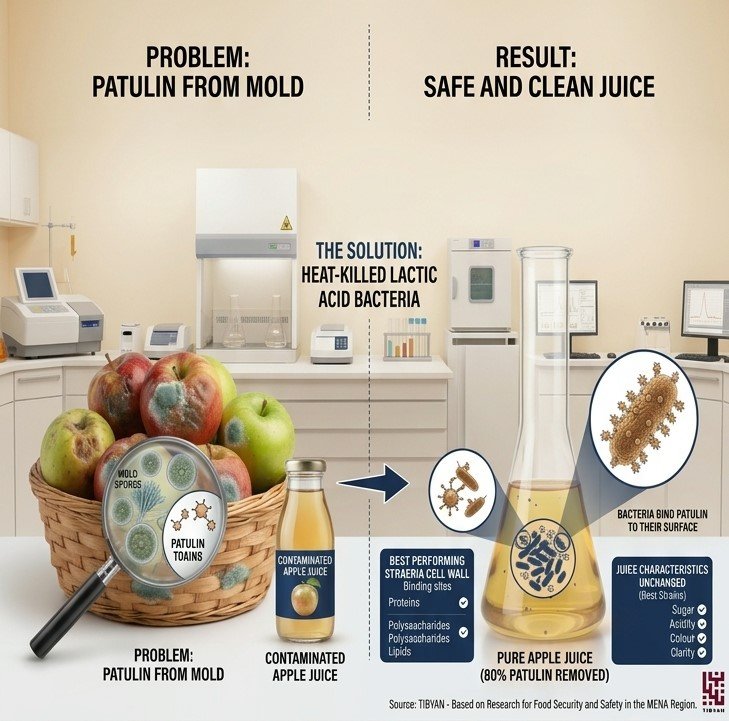
Patulin, a toxin from mould-damaged apples, can end up in juice. In lab tests, heat-killed lactic acid bacteria bound up to 80% of it while leaving the juice’s sugar, acidity and colour unchanged. A promising biological approach to safer apple products.
A hidden risk in an everyday drink
Apple juice has a reputation for being wholesome. But apples that are bruised, cracked or poorly stored can be colonised by moulds such as Penicillium expansum, and these moulds produce patulin, a toxin that can pass from the rotten spot into the surrounding flesh and eventually into the juice. Patulin is a food safety problem and an economic one. Contaminated batches can be rejected, and processors who cannot show control over it lose market access.
Existing fixes, such as clarification, filtration, chemical treatment and irradiation, are not always practical. Some are costly, some raise chemical or environmental concerns, and some are hard to run in a normal processing line. Our team at Northwest A&F University asked a simpler question: could harmless bacteria that people already eat in fermented foods act as a “sponge” for the toxin?
What we did
We tested ten strains of lactic acid bacteria, including Lactobacillus, Bifidobacterium and Enterococcus species. All were killed by heat before use, so they could not grow or ferment in the juice. We then added the dried cells to apple juice spiked with patulin, shook the mixture for 24 hours, and measured how much toxin was left.
What we found
- Every strain removed some patulin. Removal ranged from roughly 47% to 80%, and it depended strongly on the strain.
- Two strains stood out. Lactobacillus rhamnosus 6224 removed about 80% of the toxin, and Enterococcus faecium 21605 about 65%.
- Conditions matter. Binding worked best at 30 °C. It also worked best at the lowest toxin level we tested (100 µg/L). When we doubled the toxin level, removal by the two best strains fell to roughly a quarter, which suggests the bacterial surface has a limited number of binding sites.
- The juice stayed the same. For the best-performing strains, sugar, acidity, colour and clarity were not meaningfully different from untreated juice. One strain (L. rhamnosus 6133) did dull the juice’s colour and clarity, which is another reminder that strain choice matters.
How does it work?
Infrared spectroscopy of the cells before and after exposure to patulin pointed to the cell wall as the main binding site. Proteins, polysaccharides and other surface groups appeared to be involved. This fits the idea that the bacteria bind the toxin to their surface and do not break it down, though we noted that the exact mechanism still needs further study.
Why it matters for development and food systems
Food safety is often treated as a purely technical issue, but it also shapes health, trade and livelihoods. Toxins such as patulin can lead to rejected batches, wasted produce and lost income, and the burden tends to fall hardest on small and medium agri-food businesses that have limited access to costly technologies and testing.
This study points to the kind of solution that evidence-based policy and practice can build on: a low-input biological approach that, if it proves workable at scale, could widen the options available to processors. Strengthening food safety also supports food security, protects consumers and helps producers in the Middle East and North Africa meet the quality demands of local and export markets.
Turning laboratory findings like these into practice depends on exactly the work Tipyan promotes: research, capacity building for processors and regulators, and partnerships between scientists, industry and policymakers.
Limits and next steps
This was a laboratory study on spiked juice, so it is a proof of concept and not a ready-to-use process. Before industrial use, researchers would need to test it at larger scale and with naturally contaminated juice. They would also need to work out how to remove the spent cells from the juice, confirm which strains are suitable for food use, and clear regulatory requirements. Those steps are where research partnerships with industry and policy support become important.
Read the original paper
Hatab S., Yue T., Mohamad O. (2012). Removal of patulin from apple juice using inactivated lactic acid bacteria. Journal of Applied Microbiology, 112, 892–899. https://doi.org/10.1111/j.1365-2672.2012.05279.x
This summary is an original plain-language account of the published study. All rights in the original article remain with its publisher and authors.